

Japanese Thin Capitalization Rule: Overview
Dividends are paid from after-tax profits, whereas interest is generally deductible for Japanese corporate tax purposes and paid from pre-tax income.
To prevent international tax avoidance by exploiting this difference, Japanese tax law imposes a restriction mechanism known as the “Thin Capitalization Rule.”
This article outlines the overview and structure of the Japanese Thin Capitalization Rule.
Note: The Thin Capitalization Rule explained below applies to Japanese domestic corporations/subsidiaries.
For Japan branches of foreign corporations, separate interest deduction limitation rules, such as the PE Attribution Rule, apply instead of the Thin Capitalization Rule.
Purpose of the Rule
When a foreign parent company establishes a subsidiary in Japan, it provides capital to the subsidiary. Generally, funding is provided either entirely as equity (capital stock) or as a combination of equity and intercompany loans.
- Equity Funding:
The parent company receives dividends paid out of the subsidiary’s after-tax profits. - Debt Funding:
The Japanese subsidiary pays interest to the parent company. Because interest payments are generally deductible expenses, the subsidiary can reduce its taxable income subject to Japanese corporate tax.
Because debt funding can reduce the subsidiary’s Japanese tax burden, this structure may be used for tax avoidance. To counteract this, Japanese tax law restricts the deductibility of interest paid to foreign parent companies based on debt-to-equity ratios.
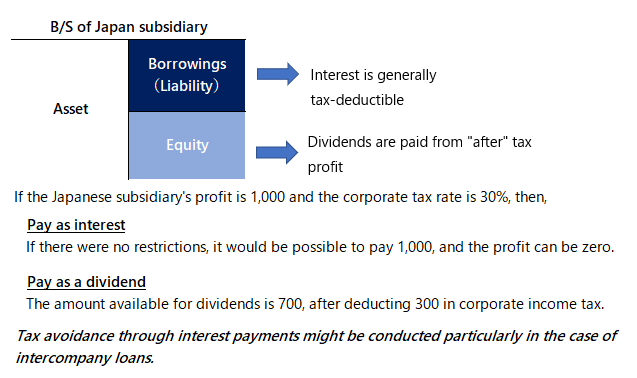
For simplicity, the following explanation assumes that a foreign parent company holds 100% of the shares in a Japanese subsidiary and provides loans directly.
Requirements for Application to Japanese Subsidiaries
Under the Japanese Thin Capitalization Rule, the rule generally applies if the balance of a Japanese subsidiary’s liabilities to its foreign parent company exceeds three times the foreign parent company’s equity interest.
In other words, if the debt-equity ratio of a Japanese subsidiary with respect to its foreign parent company exceeds 3:1, restrictions will be imposed on the deductibility of interest payments made by the Japanese subsidiary to the foreign parent company.
(Cases where the Thin Capitalization Rule Applies and Cases where it Does Not)
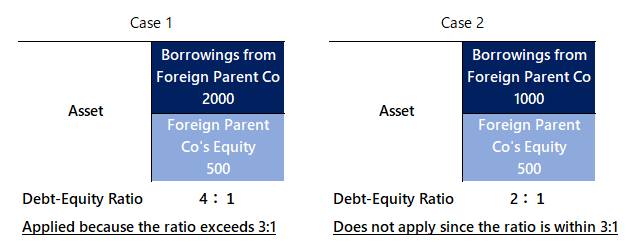
Key Points in Testing Application
More precisely, the rule applies based on the ratio of average interest-bearing debt to average equity capital.
- Average interest-bearing debt:
Japanese tax law requires using at least the average of monthly closing balances throughout the fiscal year as the “average interest-bearing debt”. - Equity Capital Portion:
Generally based on the average balance of net assets calculated on a monthly basis. However, if the year-end amount of capital stock and capital surplus exceeds the average net assets, the year-end capital amount can be used.
Calculation of Non-Deductible Interest Amount
When the Thin Capitalization Rule applies, the non-deductible portion of the interest expense is calculated as follows:

The following example shows how to calculate the disallowed amount when a wholly owned subsidiary pays interest to its foreign parent company.
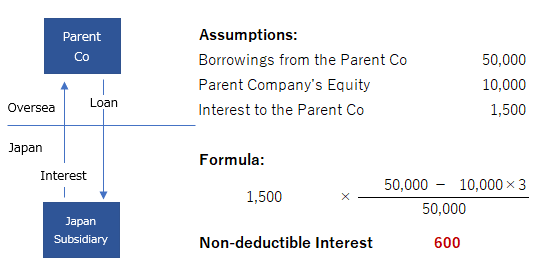
As illustrated above, only the portion of interest corresponding to debt in excess of 3 times the parent’s equity capital portion is treated as non-deductible.
Withholding Tax on Interest Payments
Even if an interest payment is disallowed as a tax deduction under the Thin Capitalization Rule, its tax classification does not change. A withholding income tax of 20.42% (or a reduced rate under an applicable tax treaty) continues to apply to the full amount of interest paid to the foreign parent.
Guarantee Fees Paid to Foreign Parents
If a Japanese subsidiary borrows money from an unrelated third-party bank under a guarantee provided by its foreign parent and pays guarantee fees to the foreign parent, such guarantee fees may also fall under the scope of the Thin Capitalization Rule.
Comparable Company Exception
For entities whose business nature inherently requires a debt-to-equity ratio exceeding 3:1 (e.g., financial institutions), taxpayers may elect to select comparable companies and use their industry debt-to-equity ratio instead of the default 3:1 threshold.
Entities Owned Below 100%
While a 100% owned subsidiary is used as a model here, the Thin Capitalization Rule can apply if a foreign parent group holds a direct or indirect ownership of 50% or more in the Japanese subsidiary.
Other Interest Deduction Limitation Rules
In addition to the Thin Capitalization Rule, intercompany interest paid to foreign related parties may be subject to limitations under the Japanese Earnings Stripping Rule and Transfer Pricing Rules.
————
This post is a summary based on the applicable tax laws and regulations of Japan effective as at the date hereof. Before making any decision or taking any action, you should consult with other professionals or us.