

Japanese Earnings Stripping Rule: Overview
Under Japanese tax law, the Earnings Stripping Rule is stipulated as a measure to prevent international tax avoidance through excessive interest payments. This article provides an overview of the Japanese Earnings Stripping Rule.
For ease of explanation, this article assumes a case in which a Japanese entity pays interest on a loan borrowed from a foreign affiliate, and no other Japanese entities exist besides that entity.
Overview of the Rule
Under Japanese tax law, the Earnings Stripping Rule limits the deductibility of interest expenses. If a corporation’s “Net Target Interest Payments” exceed 20% of its “Adjusted Taxable Income” (Tax-EBITDA) for a fiscal year, the excess amount is disallowed as a deductible expense.
Broadly, the calculation mechanism for interest on a loan is illustrated as follows: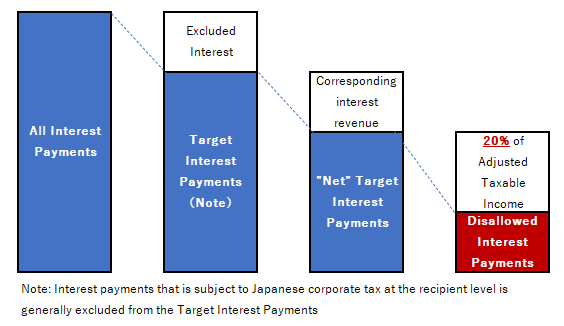
Net Target Interest Payments
Previously, this rule applied only to interest paid to related parties. However, under the current tax law, it applies broadly to interest paid to both related and unrelated parties if the interest is not subject to Japanese corporate tax at the recipient’s level. Therefore, for loan interest, interest paid to an entity outside Japan is generally treated as Target Interest Payments under the Japanese Earnings Stripping Rule, regardless of whether the recipient is a related party.
“Net” Target Interest Payments are then calculated by deducting corresponding interest income from these Target Interest Payments.
Note that different rules may apply to interest on bonds.
Adjusted Taxable Income (Tax-EBITDA)
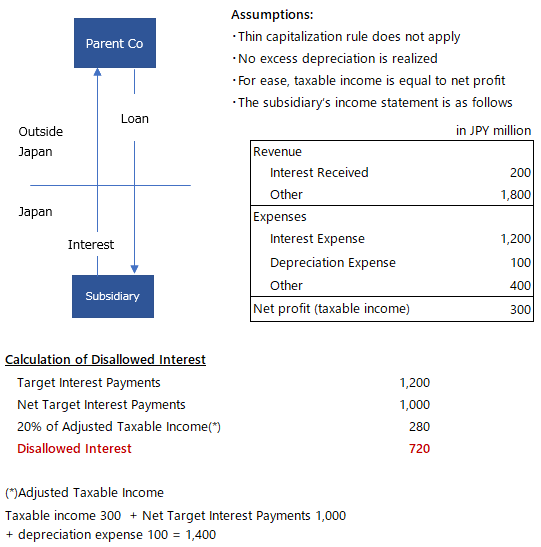
Adjusted taxable income is calculated by adding back certain items, such as the Net Target Interest Payments and depreciation expenses, etc, to the taxable income for a fiscal year of a corporation.
As the Adjusted Taxable Income is similar to EBITDA, it is sometimes called Tax-EBITDA.
Exemptions (De Minimis Rules)
The Earnings Stripping Rule does not apply if the Net Target Interest Payments for the business year are JPY 20 million or less.
(Note: If other related domestic entities exist in Japan, a separate group-based exemption rule may apply based on the entire group’s net target interest payments and adjusted taxable income.)
Carryforward of Disallowed Interest
As a general rule, interest expense disallowed under this rule (excess interest) can be carried forward for up to seven succeeding business years. However, as a special measure, excess interest arising in fiscal years beginning between April 1, 2022, and March 31, 2025, can be carried forward for up to ten succeeding business years.
The carried-forward excess interest can be deducted in subsequent years up to the limit of 20% of the adjusted taxable income minus the Net Target Interest Payments for that fiscal year.
Example of Disallowed Interest Calculation
Below is a simple example of calculating disallowed interest under the Japanese Earnings Stripping Rule, which assumes a Japanese subsidiary pays interest to its parent corporation outside Japan.
Relationship with Thin Capitalization Rule
In some cases, both the Earnings Stripping Rule and the Thin Capitalization Rule may apply simultaneously.
When non-deductible interest arises under both rules concurrently, the rule that results in the larger non-deductible amount is applied to disallow the interest deduction.
Unlike the Earnings Stripping Rule, the Thin Capitalization Rule does not have a provision for carrying forward the disallowed excess interest to subsequent business years.
————
This post is a summary based on the applicable tax laws and regulations of Japan effective as at the date hereof. Before making any decision or taking any action, you should consult with other professionals or us.